

This post contains paid and/or affiliate links. I make a small commission at no extra cost to you. Please see our Privacy Policy.
You know that feeling when you’re gripping the steering wheel so tight your knuckles turn white? Yeah, that’s pretty much how most of us approach life. We think if we just control everything—our careers, relationships, finances, futures—we’ll finally feel secure. Spoiler alert: it doesn’t work that way. When you surrender control to God, it isn’t about giving up; it’s about finally trusting the One who’s been in control all along.
Table of Contents
Let me be real with you—letting go and trusting God is probably one of the hardest things we’ll ever do as Christians. But it’s also the most freeing.
Why We Struggle to Surrender to control God
Here’s the thing: we’re control freaks by nature. Ever noticed how we plan every detail of our lives, only to watch them fall apart anyway? That’s because we’re trying to play a role we were never meant to fill.
I remember planning my entire career trajectory down to the month. Had spreadsheets, backup plans, and contingency strategies. Then life happened—as it always does—and absolutely nothing went according to plan. However, looking back now, I can see how God’s plan was infinitely better than mine. But in the moment? I was stressed, anxious, and convinced I needed to control every outcome.
Control gives us the illusion of security. We think if we micromanage every aspect of our lives, we’ll avoid pain, failure, or disappointment. But that’s exhausting, isn’t it? And honestly, it’s pretty arrogant when you think about it. We’re essentially telling God, “Thanks, but I’ve got this.”
What Does a Devotional on Surrender Actually Mean?
Surrender isn’t waving a white flag in defeat. It’s recognizing that God’s got better vision than we do—like, infinitely better. Faith over control means choosing to trust God’s wisdom over our limited understanding.
Think about it this way: if you were lost in a city and someone offered you a map versus a helicopter view, which would be more helpful? We’re down here with our maps, trying to figure out the next turn. God’s got the helicopter. He sees the whole route, the traffic jams ahead, and the shortcuts we’d never find on our own.
So what does biblical surrender look like? Here are the key components:
- Acknowledging God’s sovereignty over every area of your life
- Releasing your grip on outcomes you can’t control anyway
- Trusting God’s timing even when it makes zero sense
- Accepting His will over your carefully crafted plans
This isn’t passive resignation. It’s active trust. Big difference.
The Freedom That Comes from Letting Go and Trusting God
Okay, real talk—when I first started practicing surrender, I felt terrified. What if God’s plan isn’t what I want? What if I don’t like where He leads me? But here’s what I discovered: spiritual peace doesn’t come from getting everything we want. It comes from trusting that God wants what’s best for us.
Remember the story of Peter walking on water? He was doing fine until he took his eyes off Jesus and focused on the storm. That’s us, constantly. We start trusting God, then we look at our circumstances and freak out. Consequently, we sink.
Letting go brings incredible freedom. When you’re not constantly trying to control everything, you actually have energy for what matters. You sleep better. You worry less. You stop carrying burdens you were never meant to carry in the first place.
Also, surrender opens doors you didn’t even know existed. When I stopped forcing my career path and started asking for God’s guidance, opportunities showed up that I never would’ve pursued on my own. And they were better—way better than anything I’d planned.
Practical Steps to Surrender Control Daily
Let’s get practical, because “just surrender” is about as helpful as “just relax” when you’re stressed. Here’s how to actually do this:
Start Your Day with Surrender
First thing in the morning, before checking your phone or mentally reviewing your to-do list, pray a simple prayer of surrender. Mine’s usually something like: “God, today is Yours. My plans are Yours. Help me trust You with whatever happens.”
It doesn’t need to be fancy or eloquent. Just honest.
Identify Your Control Areas
Next, figure out where you’re white-knuckling life. Is it your finances? Your kids’ futures? Your health? A relationship? Write them down. Then, one by one, practice releasing them to God.
FYI, this isn’t a one-and-done thing. You’ll probably need to surrender the same things multiple times. That’s normal. I surrender my anxiety about the future approximately 47 times a day.
Replace Worry with Worship
When you catch yourself spiraling into control mode, stop and worship instead. Seriously. Play a worship song, recite a verse, or just thank God for something. This shifts your focus from the problem to the Problem-Solver.
Some of my go-to verses for devotional on surrender:
- Proverbs 3:5-6 – “Trust in the Lord with all your heart…”
- Philippians 4:6-7 – “Do not be anxious about anything…”
- Psalm 46:10 – “Be still and know that I am God”
Practice Small Surrenders
Finally, start with the small stuff. Surrender your schedule for the day. Surrender that difficult conversation you’re dreading. Surrender your expectations for how something should go.
Small surrenders build your trust muscles for the bigger ones.
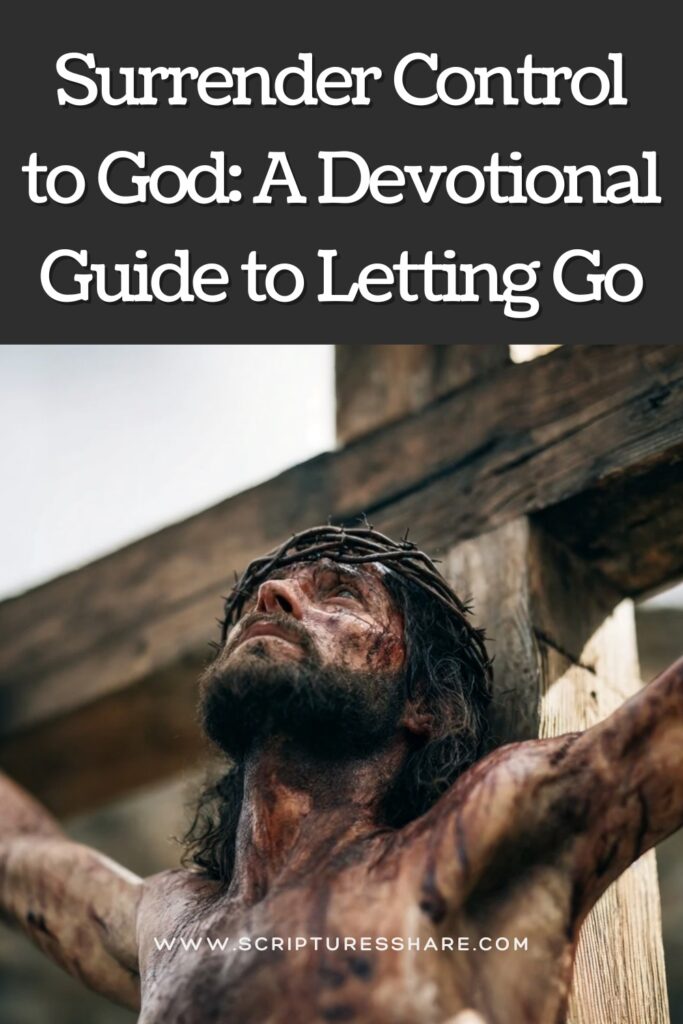
When Surrender Feels Impossible
Let’s be honest—sometimes surrender feels completely impossible. Life gets hard, circumstances feel overwhelming, and trusting God seems like a nice idea for other people but not for your situation.
I get it. There’ve been seasons where I’ve been angry at God, confused by His timing, and totally unable to see how anything could work out. But here’s what I learned: surrender isn’t a feeling. It’s a choice you make even when your emotions are screaming the opposite.
On the other hand, God doesn’t expect perfection. He knows we’re going to struggle with this. He’s not up there with a clipboard, marking us down every time we slip back into control mode. He’s patient. He’s kind. And He understands that learning to trust Him is a process.
Therefore, give yourself grace. Some days you’ll surrender beautifully. Other days you’ll try to control everything and realize (again) that it doesn’t work. That’s part of the journey.
The Real Goal: Intimacy with God
Here’s something that changed my perspective: surrender isn’t ultimately about getting better outcomes (though that often happens). It’s about intimacy with God.
When you surrender control, you’re saying, “God, I trust You. I believe You’re good. I’m choosing relationship with You over my need for certainty.” That deepens your connection with Him in ways nothing else can.
Ever wondered why the most peaceful Christians you know often have the hardest stories? It’s because they’ve learned surrender through fire.
They’ve discovered that God’s presence is more valuable than God’s presents. And honestly, that’s where real spiritual peace lives—not in controlled circumstances, but in trusting God regardless of circumstances.
Moving Forward in Freedom
So where do we go from here? IMO, start today. Start small. Pick one area you’ve been controlling and practice releasing it to God. Pray about it. Journal about it. Talk to a trusted friend about it.
And remember—God’s guidance is always available. He’s not playing hide-and-seek with His will. He wants to lead you even more than you want to be led. As a result, when you genuinely surrender, He’ll show you the next step. Maybe not the whole staircase, but definitely the next step.
Letting go and trusting God is a daily practice, not a one-time decision. Some days will feel easier than others. But every time you choose surrender over control, you’re building a life of greater peace, purpose, and intimacy with God.
The tightest grip we can have is the one we release into God’s hands. Sounds paradoxical, right? But it’s true. So take a deep breath, loosen your grip, and watch what God does with what you’ve been holding onto so tightly.
Trust me—He’s got this. Actually, forget trusting me. Trust Him. That’s the whole point.